Here you will find some information and thoughts about the Swedish board game Finans, mostly the Swedish version from 1983. My name is Peter and I created this website to promote the game and maybe connect with other Finans fans. The information here reflects my interest in the game and is not intended to be comprehensive.
Use the menu above to navigate.
Since then, it's been remade a few times. For many years the name Nya (New) Finans was used. It's been published in Denmark, Finland and Norway. The Finnish name used to be Finanssi but nowadays it's called Pelaa kuin miljonääri (Play like a millionaire).
In the seventies, a variant called Datafinans (Computer Finans) existed for a short while, but that game differs quite a lot from the original.
Some information about the games is available on BoardGameGeek:
The current Swedish game on the publisher's website (in Swedish):
Boken om Alga ("The Book about Alga") from 2019 has a section about Finans (in Swedish):
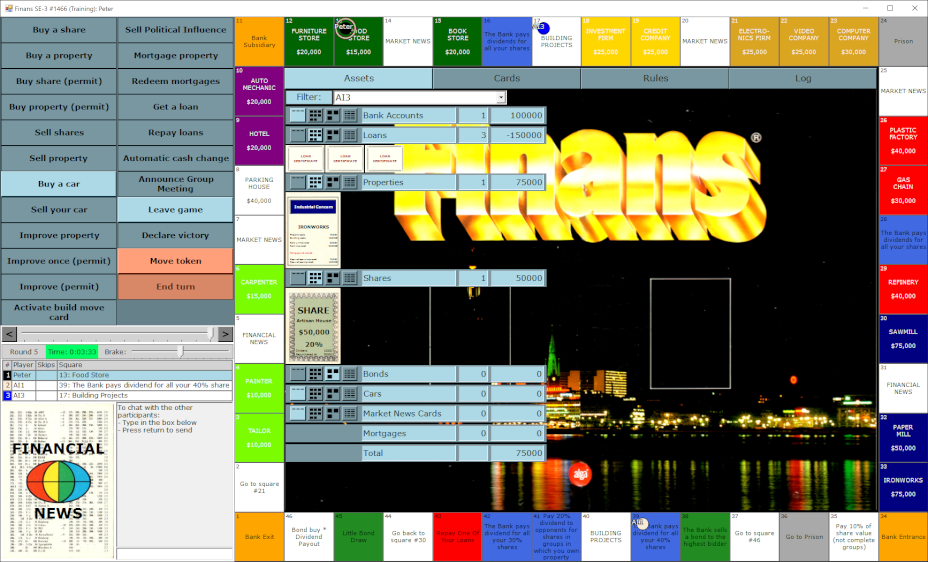
I made a digital version of Finans 1983, with online gameplay against AI and human opponents. Language options are English and Swedish. There is a ranking system. You need a Windows computer to be able to play. The project is non-profit and free to use. There are no ads.
As far as I know, all rights to the game belong to Brio AB, Sweden. Brio AB and Alga do not endorse this digital version in any way and have not been involved in its creation.
If you're interested in playing, send me an email! peter@finansfans.net
The version I grew up with came out in 1983. Behind it was Dan Glimne. Later versions hardly change anything but the graphic design.
In Boken om Alga (The Book about Alga) Glimne recounts how the game came to be. Among other things, he mentions adding the Shareholder's meeting feature, which in my view accounts for a lot of the dynamics of the game. He calls the bond draw "broken", stating that bond number 7 is always the best, which I don't agree with at all. More on that subject and other aspects of the game below.
But first, a few words about strategy. Alga writes (my translation): "Some good advice from your banker: Work out your strategy from the beginning." I beg to differ. The game is far too dynamic for that. Your strategy has to be frequently updated during the game.
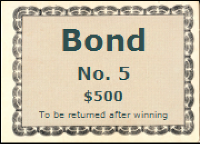 Bonds
Bonds
Let's start with the bonds. They constitute a small, but potentially decisive, part of the game. Is number 7 the best? Usually no. It can never win second or third prize. No 6 wins first prize almost as often (5 times out of 36) as does no 7 (6 out of 36). In addition, it often wins second prize (a whopping 11 times out of 36). And time is money, also in this game. If you look at the average (expected value) prize money for the first draw, number 6 is not the only bond beating number 7, but so does 5, 4, and even 3!
The advantage of the high numbers is of course that when they win, it's always first prize. So opting for a high number increases the chance of winning big, which may be a good move if you are very poor or very rich.
Bond no 1 may also be a good choice in some situations since there is a card forcing your opponent to pay prize money to you for it.
 Loans
LoansThere are six loans, and each player is allowed to have a maximum of three at any given time. However, there is no limit to how many you are allowed to take at the same time, meaning that in games with more than two players, only the first two will start out with loans.
Since taking loans is advantageous, loanless players will start the game worse off. I don't think that's such a bad thing however, since it makes the game more dynamic. It's like white and black in chess. Sometimes you start without loans, you're the underdog and you need to play a different game. Also, you have a chance of acquiring loans as other players lose them.
The fact that loans can be repaid without interest at any time makes it a good tactic to repay loans when approaching square 1 and retake them before you end your turn (which is almost always possible). This is in accordance with the rules. I suspect that it would be better if loans were always repaid with interest.
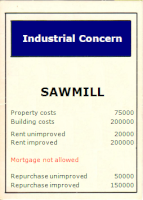 Sawmill
This property is by far the most common square to land on, due to the go-back-to square inside the bank. It is therefore somewhat exceptional and often decides the game.
Does that mean the first player to buy the Sawmill will always win the game eventually? Absolutely not, I say. The building cost is outrageous and the selling price is bad. Opponents may be able to counteract you by buying the corresponding shares. It may take quite some time before you are able to build there. Unless you own two more buildings, there is a risk of a giant loss from drawing the Fire card. Often though, seeking to acquire and build on the Sawmill property is a very good strategy when it comes to expected value. It does however come with a high risk.
 Rule issues
Game rules formulated in natural language are seldom consistent and complete. When trying to express them in a formal language, as I have done programming the game logic for Finans, that becomes glaringly obvious. People often fill in the blanks in what they think is the only reasonable way, problem is, not everyone arrives at the same conclusion. Here's a list of some of the things I discovered.
It would be great to hear from other fans of Finans. Feel free to email a line or two to this address.